Show summary Hide summary
Summary:
- Why Lanzarote’s volcanic terrain shapes the way you explore.
- Where to find the island’s most meaningful cultural landmarks.
- The coastline areas that offer distinct moods.
- Local dishes worth discovering.
- Why La Graciosa remains one of the quietest escapes in the archipelago.
Lanzarote is often described as an easy sunny escape, yet its deeper charm emerges when you look closely at the land. Past eruptions left behind long lava corridors and quiet plains where the wind flows freely. Walking here feels like reading a landscape written in stone, and each shape adds a layer to the story of the island. Two steps in and you already sense how different this place is.
This guide focuses on five angles that help you navigate Lanzarote with clarity: its volcanic traces, the influence of César Manrique, the varied coastline, the local cuisine, and the peaceful world of La Graciosa. These elements offer a simple way to understand what makes the island memorable. Let’s dive in.
Bhutan: the country that quietly slows you down (and you’ll thank it for)
Europe in 2026: the trips worth planning around real dates
Volcanic traces that still guide the eye
To understand Lanzarote, you need to look at its surface. The major eruptions of the 18th and 19th centuries shaped the muted palette that defines the island today: deep reds, greys, and ochre shades. Nowhere is this more visible than in Timanfaya National Park, where craters and lava fields stretch far into the distance.
Access to the heart of the park is restricted, but the guided routes and bus circuit provide close views of the island’s most dramatic terrain. Even from your seat, the textures speak for themselves.
Further afield, the volcanic story continues: at Los Hervideros, the ocean cuts into lava flows; in the Cueva de los Verdes, you follow a tunnel created by past eruptions; and at Jameos del Agua, the landscape softens into a space shaped by water and stone. Each place shows a different side of Lanzarote’s geological identity.
César Manrique’s touch: a dialogue between art and land
César Manrique, born in Arrecife, played a quiet yet powerful role in how Lanzarote developed. His work blends natural forms and human design, creating spaces that feel deeply connected to the surrounding land.
Places worth adding to your route
- Mirador del Río, offering a sweeping view of La Graciosa.
- Jardín de Cactus, a sculpted garden set in volcanic rock.
- César Manrique Foundation, a house partly carved into basalt bubbles.
- Casa-Museo del Campesino, showcasing rural traditions and local architecture.
Exploring these sites helps you understand why the island looks so cohesive, even as tourism grew over time.
Coasts shaped by wind, sand, and silence
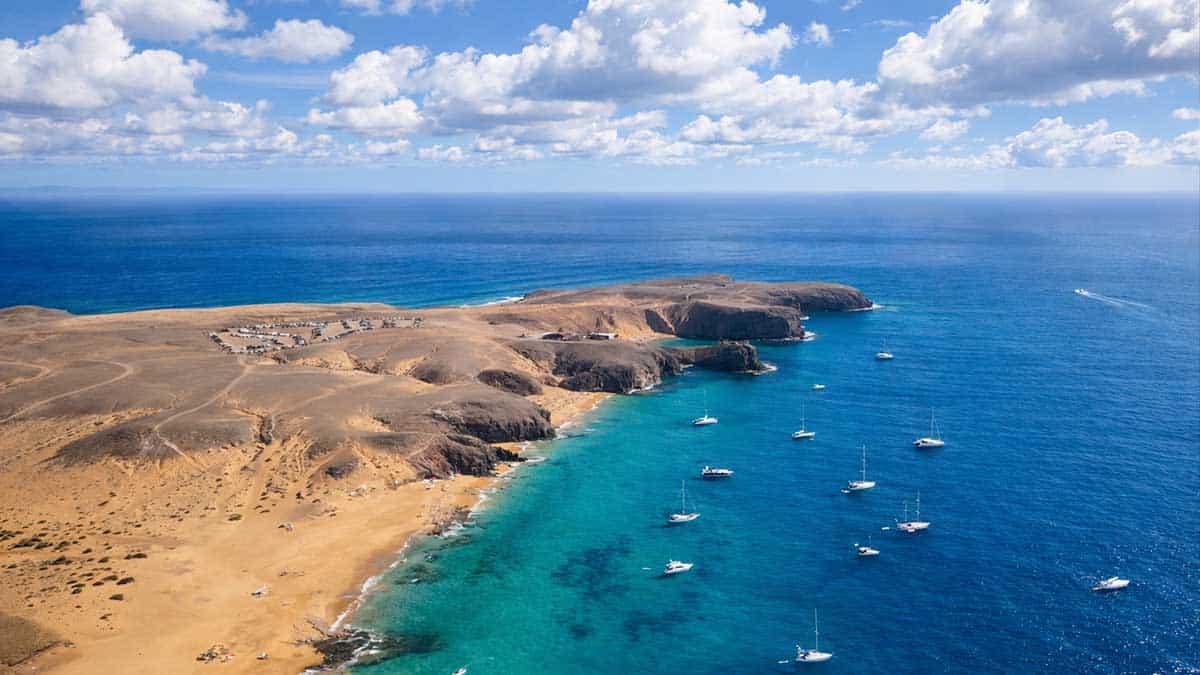
The coastline of Lanzarote shifts quickly from gentle coves to raw Atlantic stretches. In the south, the calm coves of Papagayo reward those willing to walk or follow a dusty track. Their shallow turquoise water and soft sand create a peaceful setting that feels tucked away from everything.
On the western coast, the atmosphere changes. Famara extends along a wide beach beneath towering cliffs. On windy days, the place feels alive, with lines of surfers heading toward the waves and long trails of sand drifting across the shore.
Coastal highlights at a glance
- El Golfo, known for its bold contrast between black rock and a green lagoon.
- Caletón Blanco, home to shallow natural pools and clear water.
| Area | Best For | What to Expect |
| Papagayo | Slow days | Calm coves, sheltered water |
| Famara | Surf & long walks | Wide beach, strong waves |
| El Golfo | Visual contrast | Black volcanic rock and green lagoon |
| Caletón Blanco | Families | Clear pools and light sand |
A local cuisine shaped by patience and proximity
Lanzarote’s food highlights a small range of ingredients, but each is used with care. The island’s dishes rely on fresh fish, local potatoes, and roasted grains, often prepared simply to bring out their natural flavor.
Dishes to try
- Papas arrugadas with mojo rojo or verde.
- Vieja (parrotfish) and cherne, commonly served grilled.
- Gofio, a roasted flour used in both savory dishes and desserts.
Drive through La Geria, and you’ll see vines growing in small hollows dug into volcanic ash. Many wineries welcome visitors for tastings, especially those producing Lanzarote’s malvasia wines.
La Graciosa: a slower world just across the water
A short ferry from Lanzarote brings you to La Graciosa, a small island where time seems to stretch out. With no paved roads and very few vehicles, life here unfolds at a quiet pace. Most people explore by foot or bike, following sandy paths that feel far removed from the mainland.
Reynisfjara right now: what changed on Iceland’s black sand beach
Europe’s 2026 travel shortlist: Madeira, Tbilisi, Milan, Glasgow
Walk toward Montaña Amarilla or along Playa de las Conchas, and you’ll discover wide open spaces where the only sound is the wind. Off-season, it’s easy to spend long stretches alone, taking in the calm of a truly untouched landscape.
Local tip
Morning ferries tend to be gentler, especially useful if you’re sensitive to motion.Lanzarote doesn’t try to impress through excess. It invites you to look closely, move slowly, and follow the shapes left by time. Its volcanic lands, cultural landmarks, beaches, and moments of quiet all work together to create a gentle and lasting travel experience. Let the island unfold at its own rhythm.