Show summary Hide summary
Summary:
- Val di Funes is tightening access to Santa Maddalena during mid-May to November to reduce congestion.
- Expect filtered car entry, more emphasis on designated parking, and a short walk to the viewpoints.
- The most photographed spots are near Santa Maddalena and St. Johann in Ranui.
- The smoothest visit is all about timing: early, late, or shoulder days.
- Respect for private meadows and marked paths is the key to a drama-free experience.
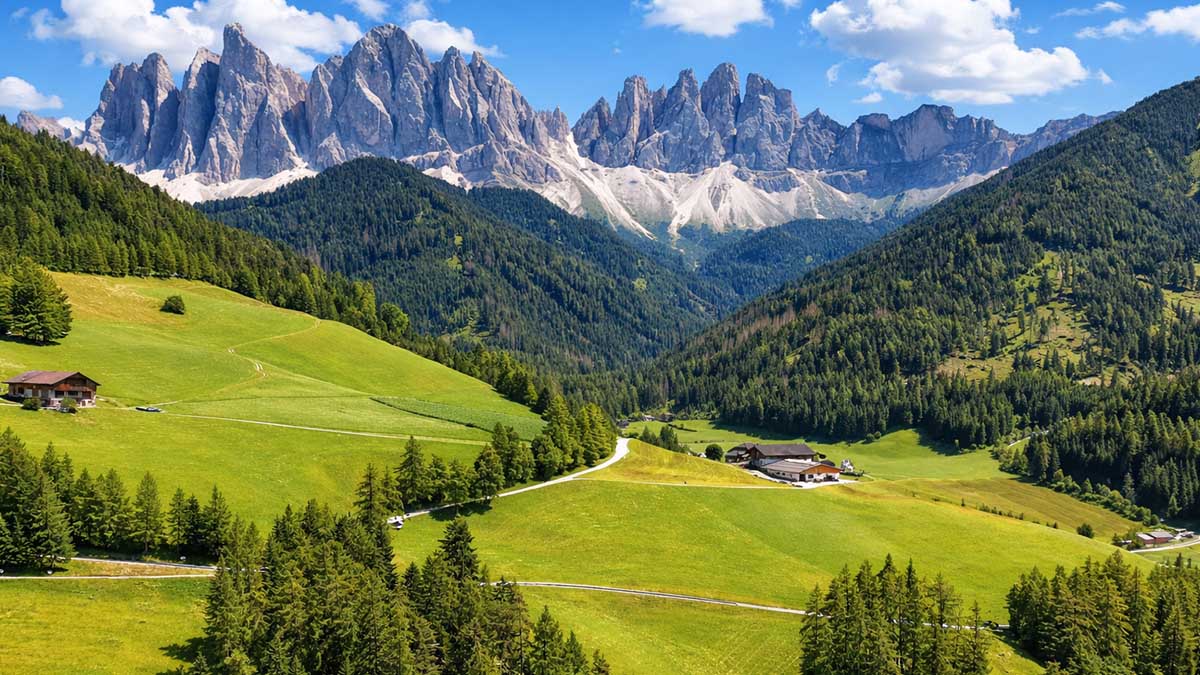
Val di Funes (Villnöss) is one of those places that looks unreal even in person. The Odle peaks rise like jagged teeth behind a patchwork of meadows, and the classic church view in Santa Maddalena feels like it was designed for a postcard. The catch is that the valley is small, the roads are narrow, and the internet has turned a quiet corner of South Tyrol into a high-speed photo pilgrimage.
If you’re planning to go in 2026, this isn’t bad news, it’s a reset that can actually improve your day. The new approach favors people who visit with a bit of patience: park once, walk a little, stick to paths, and let the valley breathe. Think of it as trading “drive, snap, leave” for a calmer, more enjoyable experience with less chaos and better light.
Solo female travel: a simple guide to feel safe, social, and fully yourself
Lascaux IV in 2026: the 10th anniversary dates worth planning around
The valley didn’t change, the way we visit did
Val di Funes has always been scenic, but the pattern of visits has shifted. More travelers now arrive for a single iconic frame, often at the same hours, then move on. That creates a surge that the valley simply cannot absorb without friction, especially when cars stack up on a thin, local road network.
What locals experience isn’t abstract. It’s blocked driveways, parking that spills into unsafe spots, and people wandering into meadows that are private or actively managed. When the same “quick stop” repeats all day long, it stops being quick for everyone, and the place starts to feel like a set rather than a living community with real daily routines.
What changes from mid-May to November, in plain terms
The plan is centered on Santa Maddalena, the hamlet most visitors try to reach by car. During the peak months, the road access is expected to be controlled, typically meaning residents and certain authorized vehicles can pass, while most visitors will be directed to park lower down and continue on foot. The intent is straightforward: reduce gridlock at the pinch point and protect the most pressured section of the valley.
In practice, you should plan for two things. First, you might not be able to drive all the way to the “closest possible” spot, even if your map suggests you can. Second, a short walk becomes part of the visit, which is honestly the better way to experience Val di Funes anyway, because you’ll notice the valley rather than staring at bumpers in front of you.
Here’s a simple expectation check:
| What you want | What will work best | What it feels like |
| The classic Santa Maddalena view | Park in designated areas, then walk | Quieter arrival, less circling |
| Predictability in peak season | Arrive early or late | Better light, fewer cars |
| Minimal hassle | Avoid midday weekends | Less waiting, more space |
| A “real” Dolomites moment | Slow down, stay longer | You’ll actually hear the valley |
If there’s one mindset shift to make, it’s this: Val di Funes is moving toward “park and walk,” not “drive to the doorstep.” That’s a win for anyone who cares about stress-free travel.
The two photo magnets, and how to handle them well
Santa Maddalena, the postcard everyone chases
This is the classic: church, village rooftops, and the Odle behind. It’s also the area where the new access controls matter most. If you arrive assuming you’ll roll up, hop out, and be gone in five minutes, you’re more likely to be frustrated. If you arrive ready to park once and walk, you’ll have a much better day.
A practical tip: treat the walk as part of the experience, not a penalty. You’ll find calmer angles, you’ll avoid the most chaotic roadside clusters, and you’ll get photos that look less like everyone else’s. The best frames often come from a few minutes of patience and a slightly different viewpoint, not from squeezing into the closest possible spot.
St. Johann in Ranui, beautiful and often surrounded by private land
St. Johann in Ranui (San Giovanni in Ranui) is another iconic stop in the valley. The important detail is that some of the most “perfect” foreground angles are near meadows that can be private or managed. The respectful approach is simple: stay on marked paths, follow signs, and don’t assume that a field is public just because it photographs well.
If you’re unsure, take the conservative route: shoot from public viewpoints, accept a wider composition, and move on. You’ll avoid awkward situations and still walk away with images that feel authentic. In a place like this, good manners travel well, and they often lead to better experiences.
The “no-drama” plan for 2026
If you want to enjoy Val di Funes instead of wrestling it, build your visit around timing and simplicity. The goal is to arrive when the valley is calm enough to feel like itself, then move through it without creating extra pressure.
Here’s a checklist that works in real life:
- Choose early morning or late afternoon, when traffic is lighter and light is softer.
- Park where you’re told to park, even if it adds a short walk, because that’s the point.
- Keep a small buffer in your schedule, so you’re not tempted into risky roadside stops.
- Stick to trails and signed routes, especially near meadows and churches.
- Support the valley in a small way, a coffee, a snack, a local shop, because it reinforces visitor value beyond photos.
Guimarães 2026: Portugal’s Green Capital you’ll actually enjoy
Greece, Croatia, Albania: three neighbors, three very different travel moods for 2026
And one more honest note: if you only have time for a rushed stop, consider skipping peak hours entirely. Val di Funes rewards people who give it 30 to 90 minutes, not three. When you slow down, you’ll notice the tiny details, the barns, the sounds, the shift in light on the peaks, and that’s what makes the valley feel worth the detour.
Val di Funes isn’t closing its doors, it’s asking visitors to arrive differently. From mid-May to November, the likely reality is less driving to the last bend and more walking from designated parking, especially around Santa Maddalena. For travelers who want the Dolomites to feel calm and real, that’s not a downside, it’s a chance to experience the valley the way it was meant to be seen, slowly, respectfully, and with room to breathe.