Show summary Hide summary
Summary:
- A colossal water-control chamber hidden beneath Kasukabe.
- How Tokyo diverts rising river levels before they reach homes.
- The surprising scale of Japan’s largest underground flood facility.
- What a guided visit feels like deep beneath the city.
When people picture Tokyo, they usually imagine its energy above ground: the flashing signs, the relentless traffic, the stations that never sleep. What they rarely picture is the water creeping along the edges after heavy rain. In the northern outskirts, several rivers can swell in minutes and the low-lying terrain offers very little escape. Storm after storm has reminded Tokyo that the real battle often happens out of sight.
A short train ride from the capital, under the town of Kasukabe, lies a structure few would guess exists: a gigantic underground chamber built to swallow sudden floods. Supported by dozens of towering concrete pillars, it redirects excess water toward a river large enough to carry it away safely. This article takes you below the surface into a world designed to protect millions of residents and offers a look at one of Japan’s most unexpected travel experiences.
Bhutan: the country that quietly slows you down (and you’ll thank it for)
Europe in 2026: the trips worth planning around real dates
Beneath Kasukabe: a colossal chamber carved in silence
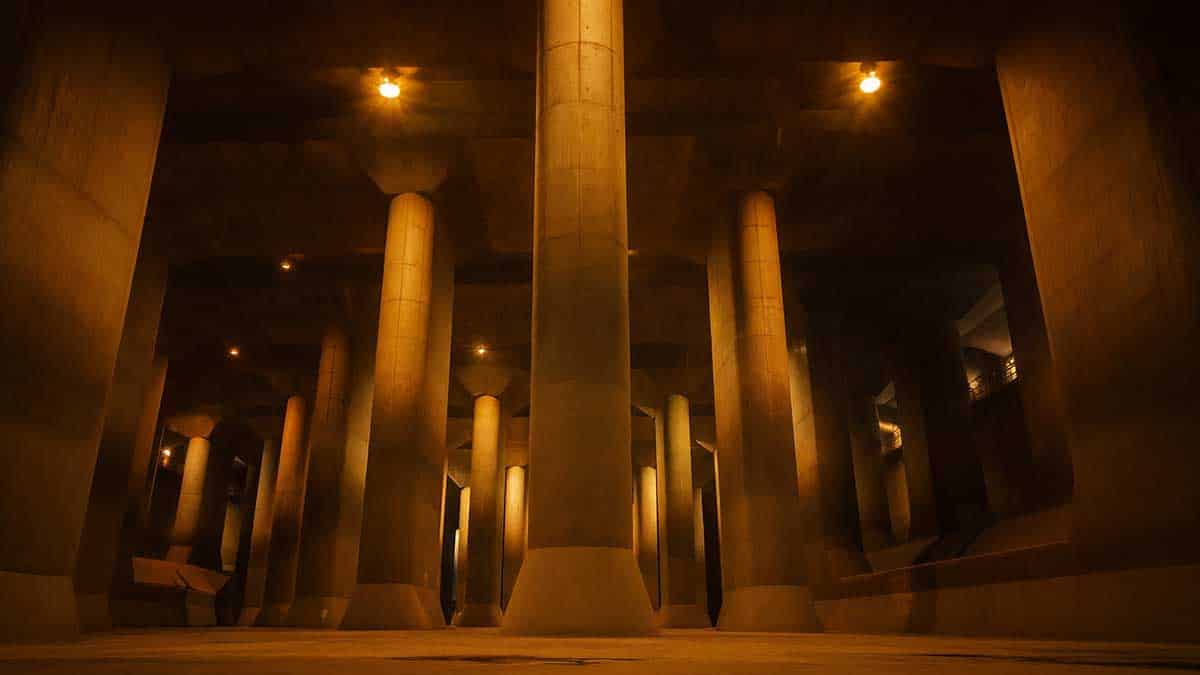
Stepping inside the Metropolitan Area Outer Underground Discharge Channel feels a little like entering a space that should belong to another world. The hall is lined with 59 concrete pillars, each rising about 18 meters high. Their size, the echo of your footsteps and the distant hum of pumps create a quietly monumental atmosphere.
The entire system runs for 6.3 kilometers beneath Kasukabe and took 13 years to complete. Its purpose is straightforward: when nearby rivers overflow, the system captures the excess through five vertical shafts and funnels it toward the Edo River. It is a deliberately hidden layer of protection that prevents surface-level neighborhoods from filling with water.
Since becoming fully operational in 2006, the facility has prevented more than 150 billion yen in flood damage. Yet it directly protects only three of Tokyo’s twenty-three wards, which shows how dense and complex the region remains.
Why Tokyo needed something this big
Tokyo’s relationship with water is long-standing. The area regularly faces intense rain, fast-rising rivers and limited space for evacuation. Typhoon Kathleen in 1947 caused massive losses, and Typhoon Hagibis in 2019 forced the cancellation of major events while severely affecting multiple prefectures. These incidents revealed how quickly river systems reach their limits.
As rainfall patterns become more unpredictable, Japan has multiplied its defenses. The Kasukabe chamber stands out for its size and clarity of purpose, acting as a buffer that absorbs the shock before the city feels it.
Water has always shaped Japan’s cities
Japan’s approach to water began long before modern engineering. More than 2,000 years ago, the first rice fields required controlled irrigation systems. Later, during the Edo period, canals and embankments shaped the city that would become Tokyo. This long history explains why structures like the Kasukabe chamber feel like a continuation of a mindset that blends anticipation with practicality.
Walk through Tokyo today and you will still notice traces of older water channels. They are reminders that the city has been adapting to heavy rain for centuries.
How other cities face rising waters
Tokyo is part of a broader discussion on how cities coexist with water. Across the world, major regions have developed their own strategies.
| Country | Approach | Example |
| Netherlands | Widening river areas | Room for the River program |
| South Korea | Restoring urban streams | Cheonggyecheon in Seoul |
| United Kingdom | Movable barriers | Thames Barrier in London |
| Italy | Lagoon protection | MOSE system in Venice |
| United States | Coastal defenses | Post-Sandy installations in New York |
Each of these projects reflects a different philosophy. Some widen waterways, others rely on barriers or restoration. Tokyo’s choice was to build downward and create a hidden space built to act instantly.
Visiting Tokyo’s flood-control giant
Reynisfjara right now: what changed on Iceland’s black sand beach
Europe’s 2026 travel shortlist: Madeira, Tbilisi, Milan, Glasgow
Although designed for utility, the Kasukabe facility has become an unexpected stop for curious travelers. Guided tours allow visitors to walk between the massive pillars and feel the sheer scale of the chamber. It is not a typical tourist site, but rather a behind-the-scenes look at how a megacity deals with water.
Guides explain how the shafts collect water, how pumps redirect it and how teams monitor incoming storms. The facility is reachable from Tokyo by public transport, and most visits require a reservation. If weather fascinates you, or if you enjoy seeing the hidden side of cities, this place offers a surprisingly captivating visit.Far beneath the surface, Tokyo hides a structure designed to catch rising water long before it reaches the streets. Standing among the tall pillars of the Kasukabe chamber, you understand the effort required to protect a city where conditions can shift in minutes. As storms become harder to predict, this underground space remains both a form of reassurance and a travel memory that stays with you.