Show summary Hide summary
Summary:
- Roads where driving is not a formality, but the heart of the trip.
- Routes that reward curiosity and patience.
- Journeys where stopping matters as much as moving forward.
- Roads you remember long after you forget the hotel.
Ask travelers what stayed with them after a trip, and many won’t mention a monument or a city center. They will talk about a stretch of road. A climb taken slowly at sunrise. A coastal drive where the sea never left their sight. These moments often feel more vivid than the destination itself.
These roads change the way we travel. They force us to slow down, to pay attention, to accept that the journey itself has value. In the following sections, we explore some of the most striking roads around the world, not as bucket-list items, but as experiences that shape how a place is discovered. Sometimes, taking the long way makes all the difference.
Bhutan: the country that quietly slows you down (and you’ll thank it for)
Europe in 2026: the trips worth planning around real dates
Roads that move at the pace of the landscape
Some roads don’t try to tame their surroundings. They adapt to them. They follow slopes, curves, and natural limits, and in doing so, they set their own rhythm. The terrain dictates the tempo, not the other way around.
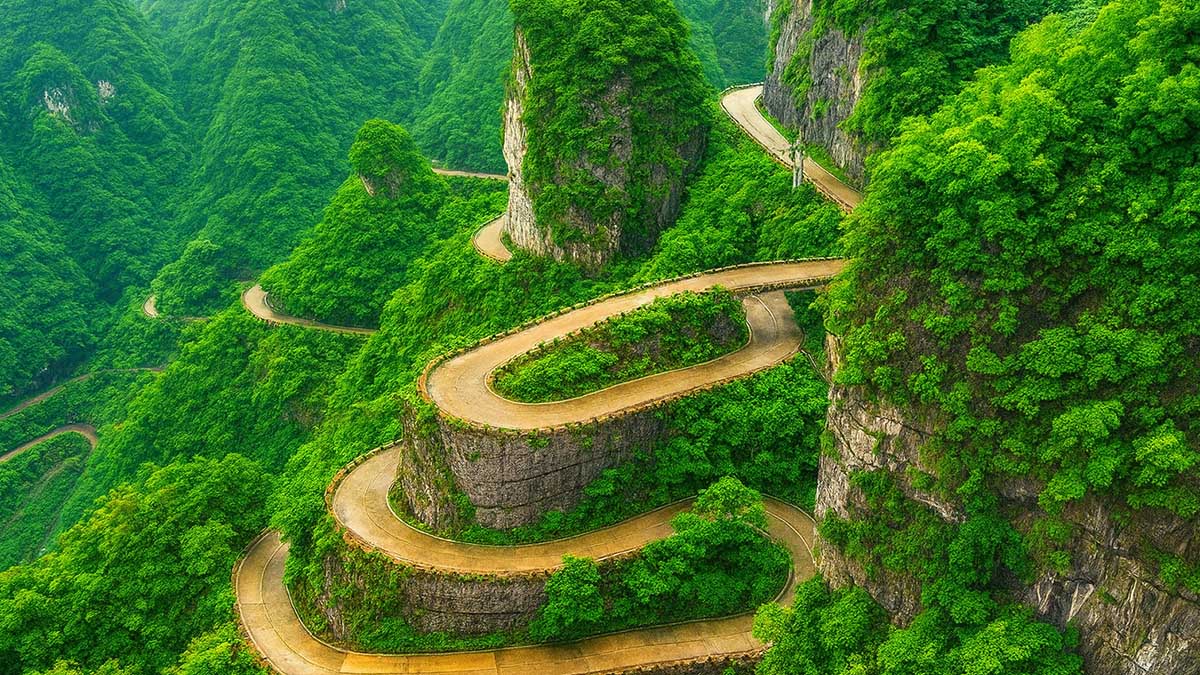
Tianmen Road, China
In China’s Hunan province, Tianmen Road climbs toward Tianmen Mountain through a sequence of 99 tight bends. The ascent feels deliberate, almost ceremonial. Each turn reveals a slightly different angle on the same dramatic scenery. The repetition of curves creates a strange mix of calm and focus.
It is not a long drive, but it demands attention. Fog can appear without warning, and the road leaves little room for distraction. Some travelers prefer to take it with a local driver. Others choose the nearby cable car, which offers a calmer way to grasp the scale of the landscape. Either way, the view stays with you.
Stelvio Pass, Italy
The Stelvio Pass cuts through the Italian Alps with a confidence that borders on stubbornness. Hairpin after hairpin, it climbs toward nearly 2,800 meters, drawing cyclists and motorcyclists from all over Europe. The road feels earned, not given.
What makes Stelvio memorable is not just its height. It is the way the climb forces you to pause and look back. In summer, when the pass is fully open, mornings offer the best conditions, with lighter traffic and softer light. Timing matters as much as skill.
Traveler’s note
Starting early changes everything. Fewer vehicles, calmer air, and a quieter atmosphere allow the road to speak for itself.
Coastal drives you don’t rush through
Driving alongside the sea alters the perception of distance. Coastal roads stretch time more than kilometers. The horizon stays open, and the rhythm slows naturally.
Great Ocean Road, Australia
Along Australia’s southern coast, the Great Ocean Road invites constant stops. Cliffs, beaches, and formations like the Twelve Apostles appear one after another, each pulling attention away from the wheel. Progress feels secondary to observation.
Beyond the famous viewpoints, small towns and national parks offer quieter moments. In less crowded sections, wildlife sightings are common, especially early or late in the day. The road rewards people who step off the main flow.
California State Route 1, USA
Highway 1 follows the Pacific coastline, connecting major cities while often feeling far removed from them. The stretch through Big Sur is the most talked about, thanks to cliffs that fall straight into the ocean and bridges suspended above ravines. The scale is constant, yet never repetitive.
Traffic can be heavy during peak periods, but patience pays off. Fog moves quickly, light shifts without warning, and even familiar viewpoints feel different within the same day. No two drives are exactly alike.
| Road | When to go | What stands out |
| Great Ocean Road | October to April | Cliffs, beaches, wildlife |
| Highway 1 (Big Sur) | April to October | Ocean views, dramatic bridges |
High roads that ask for commitment
Some routes require more than curiosity. They demand preparation, flexibility, and respect for their conditions. The effort becomes part of the memory.
Leh-Manali Highway, India
The Leh-Manali Highway crosses the Indian Himalayas at altitudes exceeding 5,000 meters. Weather can shift quickly, fuel stops are rare, and the road itself is unforgiving in places. Nothing here should be taken lightly.
Those who allow time for acclimatization are rewarded with wide plateaus, sharp peaks, and long stretches of silence. Most travelers rely on experienced drivers or organized transport, which helps reduce risk and fatigue. Planning becomes a form of respect.
Karakoram Highway, Pakistan and China
Linking Pakistan and western China, the Karakoram Highway follows ancient trade paths once used along the Silk Road. Glaciers, high-altitude lakes, and isolated villages line the route. The impression is cumulative, not instant.
Driving here is as much about context as scenery. The landscapes make sense only when seen slowly, with an understanding of how people have lived alongside them for centuries. The journey invites reflection.
What this means for you
High-altitude roads require extra days, flexible schedules, and reliable vehicles. Rushing usually leads to frustration, not discovery.
Roads that reflect a way of life
Some roads are inseparable from the people who used them. They carry traces of daily movement, economic shifts, and shared memory. They tell stories quietly, without trying to impress.
Route 66, USA
Route 66 is not about untouched scenery. It is about atmosphere. From Chicago to California, it passes diners, motels, and small towns shaped by decades of road travel. The appeal lies in what remains, not what shines.
Driving Route 66 feels like stepping into a collective memory. Even today, certain stretches seem suspended in time, offering glimpses into how travel once felt. Nostalgia is part of the ride.
Route 40, Argentina
Running along the Andes from north to south, Route 40 crosses deserts, vineyards, and the wide spaces of Patagonia. Distances are long, towns are few, and traffic can disappear for hours. Solitude becomes a constant companion.
This road suits travelers who enjoy long days behind the wheel and shifting horizons. It offers fewer highlights, but more space to observe and think. The reward is subtle, but lasting.
Choosing a road that fits how you travel
The most memorable road is not always the most famous one. It is the one that aligns with your pace, comfort, and expectations. Fit matters more than reputation.
Before choosing a route, it helps to ask yourself a few simple questions:
- Do you enjoy driving, or do you prefer frequent stops?
- How comfortable are you with isolation or changing conditions?
- How much time can you realistically dedicate to the journey?
- Is your vehicle suited to the road ahead?
Reynisfjara right now: what changed on Iceland’s black sand beach
Europe’s 2026 travel shortlist: Madeira, Tbilisi, Milan, Glasgow
Sometimes, a short mountain drive taken slowly leaves a deeper impression than a multi-day highway crossed too quickly. Intensity often outweighs distance.
The roads that stay with us rarely do so by chance. They slow us down, sharpen our attention, and reshape how we experience movement. They change the relationship between travel and time.Whether they follow coastlines, climb through mountains, or cross open land, these routes invite a different way of traveling. One that values presence over arrival. And that shift lingers long after the journey ends.